
Visual Prompt Guided Unified Pushing Policy
Published in arXiv preprint, 2026
Overview
This work proposes a unified pushing policy that incorporates a lightweight prompting mechanism into a flow matching policy to guide the generation of reactive, multimodal pushing actions. The visual prompt can be specified by a high-level planner, enabling the reuse of the pushing policy across a wide range of planning problems. Unlike existing approaches that rely on multi-step push plans composed of pre-defined pushing primitives with limited application scopes, this method provides greater efficiency and versatility.
Key Contributions
- Unified Pushing Policy: A flexible framework that can adapt to different pushing scenarios through visual prompting
- Lightweight Prompting Mechanism: Enables high-level planners to guide low-level pushing actions
- Flow Matching Integration: Uses flow matching policies to generate reactive, multimodal pushing behaviors
- VLM-guided Planning: Demonstrates integration with Vision Language Model-based planning for table-cleaning tasks
Model Architecture
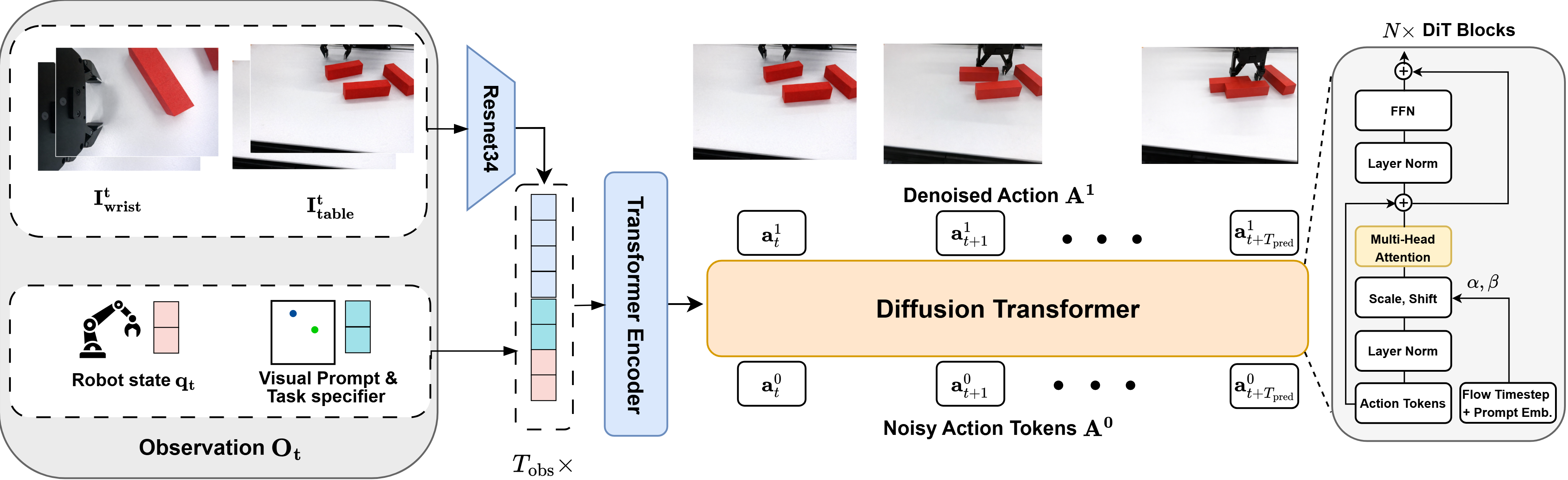
Figure 1: Policy Architecture. The input consists of the visual prompt and the latest T_obs steps of image data and robot proprioception. The policy is parameterized by a Diffusion Transformer with alternating self-attention and cross-attention DiT blocks to denoise action tokens A_0 into executable trajectories A_1.
Demonstration Video
For the demonstration video, please visit the Google Drive link to view the full demonstration of our Visual Prompt Guided Unified Pushing Policy.
Alternatively, you can watch the video directly if you have access to the shared file.
Publication Details
Authors: Hieu Bui, Ziyan Gao, Yuya Hosoda, Joo-Ho Lee
Co-Corresponding Authors: Hieu Bui & Ziyan Gao
Venue: arXiv preprint
Publication Date: 2026-02-24
arXiv: 2602.19193
*Equal contribution
Recommended citation: Bui, H.*, Gao, Z.*, Hosoda, Y., & Lee, J. (2026). Visual Prompt Guided Unified Pushing Policy. arXiv preprint arXiv:2602.19193. (* Equal contribution, co-corresponding authors)
Download Paper